Rote learning vs conceptual learning: the difference parents can actually see
Your child gets full marks on the fraction test. Two weeks later, they cannot solve a single fraction problem.
What happened?
They memorised the steps. They did not understand the concept.
Most parents hear this all the time: “Your child should focus on understanding, not memorising.”
But what does that actually look like?
Let us watch two students solve the same problem.
Two Students. Same Question.
Problem: What is 3/4 + 2/3?
Student A
When asked how to solve it, they say:
“I need to make the denominators the same.”
When asked why, they pause:
“Because… that is the rule?”
They know the steps. They cannot explain why the steps work.
Student B
When asked the same question, they explain:
“Because 3/4 and 2/3 are different-sized pieces. I cannot add them directly — it is like adding apples and oranges.”
They continue:
“So I will convert both to twelfths. 3/4 becomes 9/12, and 2/3 becomes 8/12. That gives me 17/12, which is 1 and 5/12.”
Then they add:
“That makes sense because both fractions are less than 1, so the total should be just over 1.”
Both students got the right answer.
But their understanding is completely different.
What You Just Saw
| Student A | Student B | |
|---|---|---|
| Knows the rule | Understands the concept | |
| Cannot explain why it works | Can explain their reasoning | |
| Gets stuck if they forget the steps | Can check if their answer makes sense |
One relies on memory. The other relies on thinking.
And here is the problem: rote learning works — until the question changes.
When the exam asks “Explain why we need a common denominator” or gives a word problem, Student A panics. Student B adapts.
This pattern repeats across every subject:
- Science → memorising definitions vs understanding processes
- History → memorising dates vs understanding causes
- Math → memorising formulas vs understanding relationships
One approach teaches facts. The other teaches thinking.
How Parents Can Spot the Difference
After your child finishes a problem, try this:
- Do not ask: “What is the answer?”
- Ask instead: “Can you explain why it works?”
- Do not ask: “Did you finish your homework?”
- Ask instead: “Can you teach me what you learned today?”
If they cannot explain it in their own words, they memorised it. They did not learn it.
The simplest test: Keep asking “why?” until they hit a wall. That is where the understanding gap is.
Why This Matters
The goal of education is not finishing homework faster.
It is building students who can think independently.
When students learn why, not just how, something shifts.
- They stop relying on memory and start trusting their own reasoning.
- They ask better questions.
- They feel less anxious when they encounter something new.
Understanding builds confidence in a way memorisation never can.
A Final Note
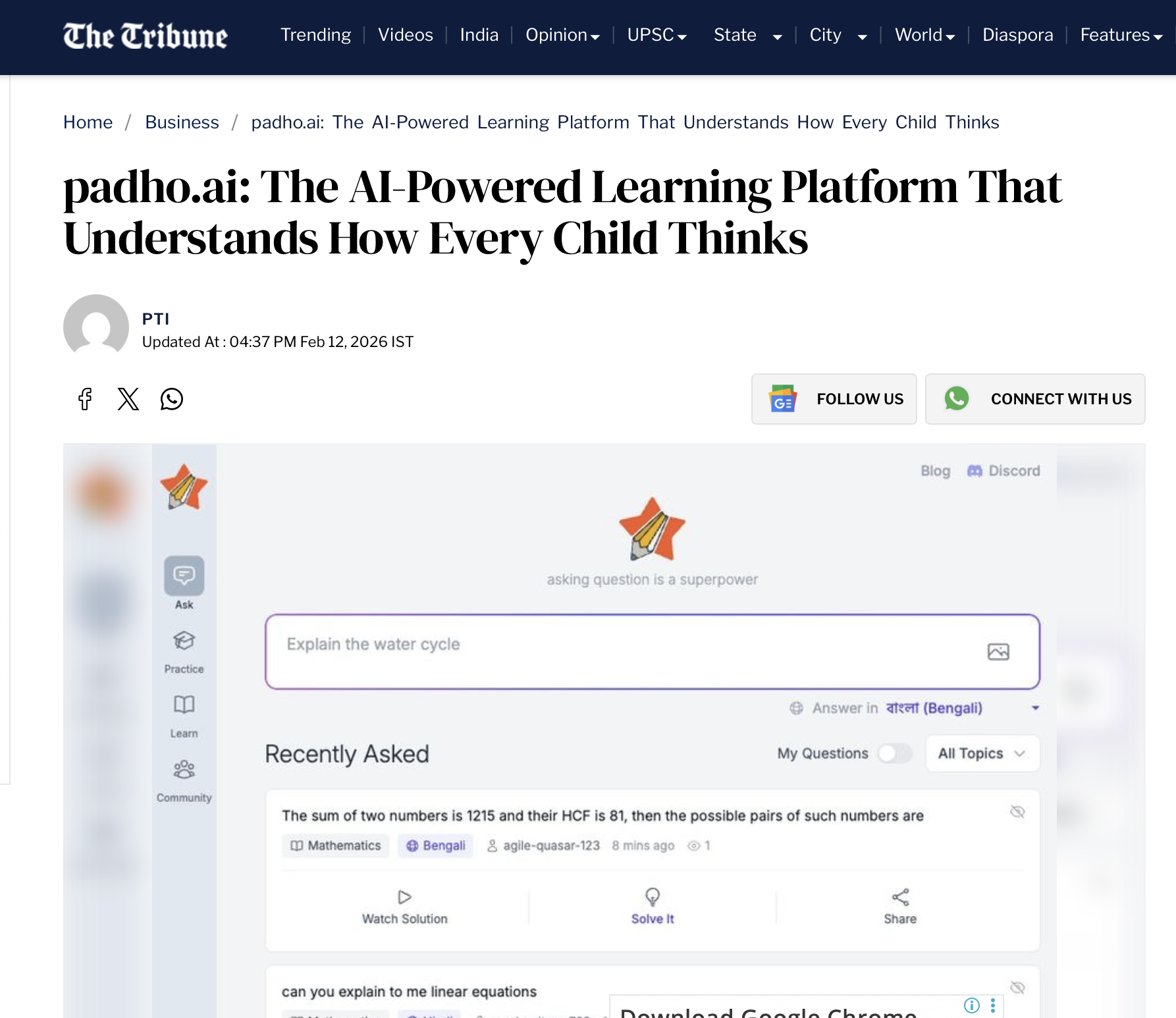
If you want help building this kind of thinking at home, that is what we designed padho.ai to do — not giving answers, but guiding students until they can explain their own reasoning.
Because the real goal is not getting homework done faster.
It is raising learners who know how to think for themselves.
Continue Exploring
• Study your own books with padho.ai, now in your language — Upload any PDF, learn in 12 Indian languages
• The stuck moment: why answers are not enough — When they follow the solution but get stuck on the next problem
• Why adaptive learning is the future of education — How personalised learning works at scale
• Learn in your mother tongue: padho.ai supports 12 Indian languages — Learning in the language you think in
Building This in Public
We recently shared our journey publicly for the first time.
We also shared our launch publicly via Hindustan Times Genesis.