Chapter 1 · Units and Measurement
1.6 Dimensional Analysis and its Applications
Every correct equation must balance in its dimensions. That gives us two powerful tools: a quick test of whether an equation can be right, and a way of finding how one quantity depends on others. This is .
1.6.1 Checking equations
Only quantities of the same kind can be added or equated; you can’t add a length to a time. So every term of a correct equation has the same dimensions. This is the . In s = ut + ½at², every term is a length, so the equation is .
s
[L]
=
ut
[L T⁻¹] × [T] = [L]
+
½at²
[L T⁻²] × [T²] = [L]
Every term is a length, so the equation passes the test.
Fig. 1.26 Every term of s = ut + ½at² is a length.
Two more rules follow. Whatever goes inside sin, cos, log or eˣ must be dimensionless. And pure numbers such as ½ or 2π have no dimensions, so this test cannot see them.
Example 1.12
The energy of a body of mass m moving at speed v at a height h is E = mgh + ½mv². Show that this is dimensionally consistent. A student writes E = mgh + ½mv instead. Show that this must be wrong.
Given
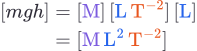
Energy: [M L² T⁻²]
g is an acceleration: [L T⁻²]
Solution
Check the first term:
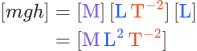
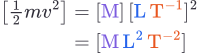
Then the second term:
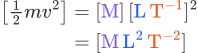
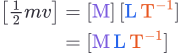
Both have the dimensions of energy, so the equation is consistent. Now check the student’s second term:
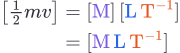
That is a momentum, not an energy, so it cannot be added to mgh.
Answer
E = mgh + ½mv is wrong
Watch out
Consistent does not mean correct
If an equation’s dimensions don’t match, it is certainly wrong. If they do match, it can still be wrong: E = mgh + mv² passes the test, but the correct term is ½mv².
Check yourself
Which of these equations cannot be right?


A centimetre is smaller than a metre, so the number should get bigger, not smaller.

That’s right
s = ut + ½at³. Its last term has the dimensions [L T⁻²] × [T³] = [L T], which is not a length.
1.6.2 Finding relations
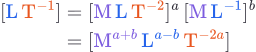
Sometimes dimensions can find an equation. What decides the T of a ? Perhaps the mass m of the bob, the length l of the string and the , g. First, our tests the mass.


0.1 kg
5 kg
Both strings 1 m · the engine measures T = 2.01 s for each


0.1 kg
5 kg
Both strings 1 m · the engine measures T = 2.01 s for each


0.1 kg
5 kg
Both strings 1 m · the engine measures T = 2.01 s for each
Fig. 1.27 Bobs of 0.1 kg and 5 kg on equal strings. Play the page to watch them swing together.
Both swing with the same period, 2.01 s. Can dimensions explain why? Suppose

(1.12)
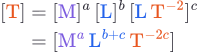
where k is a pure number. Replace each quantity by its dimensions, with g as [L T⁻²]:
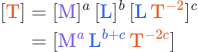
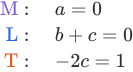
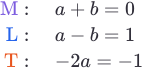
Then match the powers of [M], [L] and [T] on the two sides:
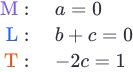
Solving these three equations,

The mass drops out, exactly as the engine showed:

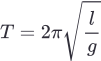
(1.13)
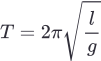
Dimensions can’t find k, but an experiment can. In Fig. 1.28 the engine times pendulums of five lengths. For every one, T ÷ √(l/g) ≈ 6.30, close to 2π ≈ 6.28; the engine’s 12° swing makes it a touch longer. So

L = 1 m
T = 2.01 s
T ÷ √(L/g) = 6.30
Periods measured by our physics engine, swinging through 12°.
String length, L
L = 1 m
0.25 m
0.5 m
1 m
1.5 m
2 m

L = 0.25 m
T = 1.01 s
T ÷ √(L/g) = 6.30
Periods measured by our physics engine, swinging through 12°.

L = 0.25 m
T = 1.01 s
T ÷ √(L/g) = 6.30
Periods measured by our physics engine, swinging through 12°.

L = 0.5 m
T = 1.42 s
T ÷ √(L/g) = 6.30
Periods measured by our physics engine, swinging through 12°.

L = 0.5 m
T = 1.42 s
T ÷ √(L/g) = 6.30
Periods measured by our physics engine, swinging through 12°.

L = 1 m
T = 2.01 s
T ÷ √(L/g) = 6.30
Periods measured by our physics engine, swinging through 12°.

L = 1 m
T = 2.01 s
T ÷ √(L/g) = 6.30
Periods measured by our physics engine, swinging through 12°.

L = 1.5 m
T = 2.46 s
T ÷ √(L/g) = 6.30
Periods measured by our physics engine, swinging through 12°.

L = 1.5 m
T = 2.46 s
T ÷ √(L/g) = 6.30
Periods measured by our physics engine, swinging through 12°.

L = 2 m
T = 2.85 s
T ÷ √(L/g) = 6.30
Periods measured by our physics engine, swinging through 12°.

L = 2 m
T = 2.85 s
T ÷ √(L/g) = 6.30
Periods measured by our physics engine, swinging through 12°.
Fig. 1.28 Five lengths, timed by our physics engine. Move the slider to change the length.
(1.14)
Example 1.13
A pendulum has a period of 2.0 s on the Earth. What would its period be on the Moon, where g is about one-sixth of its value on the Earth?
Given
Period on the Earth = 2.0 s
g on the Moon ≈ ⅙ of g on the Earth
The length l stays the same
Solution
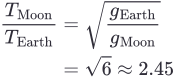
By Eq. (1.14), T is proportional to 1/√g, so
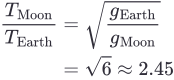
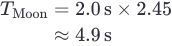
The period on the Moon is therefore
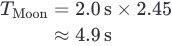
Answer
about 4.9 s
Example 1.14
The speed v of a wave on a stretched string depends on the tension F and on the mass per unit length μ. Find how v depends on F and μ.
Given
Tension F is a force: [M L T⁻²]
Mass per unit length μ: [M L⁻¹]
Speed v: [L T⁻¹]
Solution
Assume a product of powers, with k a pure number:

Replace each quantity by its dimensions:
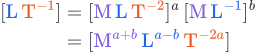
Match the powers of each base quantity:
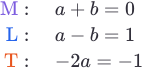
Solving these two equations,

So

Experiments show that k = 1, so v = √(F/μ).
Answer
v = √(F/μ)
Check yourself
A pendulum’s string is made four times longer. What happens to its period?
A centimetre is smaller than a metre, so the number should get bigger, not smaller.
That’s right
It doubles. T is proportional to √l, and √4 = 2.
1.6.3 Limits of dimensional analysis
Dimensional analysis cannot:
- find pure numbers such as ½ or 2π;
- build a sum of several terms, such as s = ut + ½at²;
- handle functions such as sin θ, log x or eˣ;
- find more than three unknown powers in mechanics, because [M], [L] and [T] give only three equations.
Pure numbers
like ½ and 2π
Sums of terms
like v² = u² + 2as
Functions
like sin θ, log x and eˣ
Dimensional analysis finds only a single product of powers, and only up to a pure number.
Fig. 1.29 What dimensional analysis cannot find.