Chapter 1 · Units and Measurement
1.5 Dimensional Formulae and Dimensional Equations
A quantity’s shows how it is built from the base quantities: velocity is [M⁰ L T⁻¹] and density is [M L⁻³ T⁰]. A power of 0 means that base quantity is absent. Setting a quantity equal to its formula gives a :

(1.10)
Table 1.3 lists the quantities you will meet most often. Every line follows from the definition, so there is nothing to memorise.
Table 1.3 Dimensional formulae of some quantities in mechanics
Quantity
Defined as
Dimensions
SI unit
Area
length × breadth
[L²]
m²
Volume
length × breadth × height
[L³]
m³
Density
mass ÷ volume
[M L⁻³]
kg m⁻³
Velocity, speed
distance ÷ time
[L T⁻¹]
m s⁻¹
Acceleration
velocity ÷ time
[L T⁻²]
m s⁻²
Force
mass × acceleration
[M L T⁻²]
N (newton)
Momentum
mass × velocity
[M L T⁻¹]
kg m s⁻¹
Impulse
force × time
[M L T⁻¹]
N s
Work, energy
force × distance
[M L² T⁻²]
J (joule)
Power
work ÷ time
[M L² T⁻³]
W (watt)
Pressure, stress
force ÷ area
[M L⁻¹ T⁻²]
Pa (pascal)
Frequency
1 ÷ period
[T⁻¹]
Hz (hertz)
Torque
force × distance from pivot
[M L² T⁻²]
N m
Gravitational constant, G
F r² ÷ (m₁ m₂)
[M⁻¹ L³ T⁻²]
N m² kg⁻²
Angle, strain
length ÷ length
[M⁰ L⁰ T⁰]
rad; none
1.5.1 Same dimensions, different quantities
Work and are both a force times a distance, so both are [M L² T⁻²]. Yet work changes a body’s energy, while torque turns it. Momentum and impulse also share their dimensions.
WORK
TORQUE


force

distance moved
force × distance moved



force

distance from the pivot
force × distance from the pivot
both [M L² T⁻²]
Fig. 1.23 Same dimensions, different physics: the distances are measured in different directions.
1.5.2 Dimensionless quantities
A ratio of two quantities of the same kind is : a pure number. Angle (arc ÷ radius), (change in length ÷ length), relative density and refractive index are all dimensionless.
Angle
arc ÷ radius
[L] ÷ [L]
Refractive index
speed in vacuum ÷ speed in glass
[L T⁻¹] ÷ [L T⁻¹]
Relative density
density ÷ density of water
[M L⁻³] ÷ [M L⁻³]
each = [M⁰ L⁰ T⁰]
Fig. 1.24 Each ratio cancels to [M⁰ L⁰ T⁰].
Key idea
Constants can have dimensions too. π and ½ are pure numbers, but G = 6.67 × 10⁻¹¹ N m² kg⁻² has the dimensions [M⁻¹ L³ T⁻²], so its value changes when the units change.
1.5.3 Converting units with dimensions
A dimensional formula shows how a unit is built from base units, so it lets us convert between systems. In 1 N = 1 kg m s⁻², replace the kilogram by 10³ g and the metre by 10² cm, and the newton becomes 10⁵ .
1 N = 1 kg × 1 m × s⁻²
= 10³ g × 10² cm × s⁻²
= 10⁵ g cm s⁻² = 10⁵ dyne
Swap each SI base unit for its CGS partner, then multiply the powers of ten.
Fig. 1.25 Swap each base unit for its CGS partner and multiply out: 1 N = 10⁵ dyn.
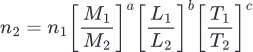
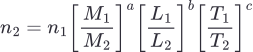
In general, a quantity with dimensions [Mᵃ Lᵇ Tᶜ] and value n₁ in units M₁, L₁, T₁ has, in units M₂, L₂, T₂, the value
(1.11)
Example 1.10
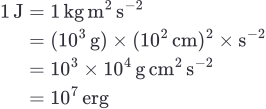
The erg is the CGS unit of energy: 1 erg = 1 g cm² s⁻². How many ergs make one joule?
Given
1 kg = 10³ g
1 m = 10² cm
1 erg = 1 g cm² s⁻²
Solution
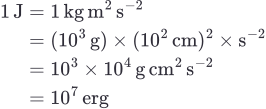
Write the joule in base units, then swap each one for its CGS value:
Answer
1 J = 10⁷ erg
Example 1.11
In a new system, the unit of mass is 10 kg, the unit of length is 1 km and the unit of time is 1 minute. What is 1 J in this system?
Given
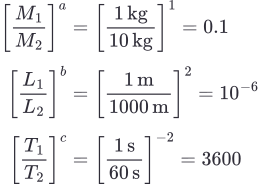
Energy is [M L² T⁻²], so a = 1, b = 2, c = −2
Mass: M₁ = 1 kg, M₂ = 10 kg
Length: L₁ = 1 m, L₂ = 1000 m
Time: T₁ = 1 s, T₂ = 60 s
n₁ = 1
Solution
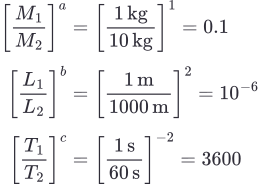
First, work out each factor of Eq. (1.11):
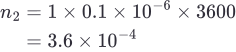
Then multiply them together:
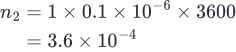
The new units are much larger, so it takes far fewer of them.
Answer
1 J = 3.6 × 10⁻⁴ new units
Check yourself
Which two quantities have the same dimensions?


A centimetre is smaller than a metre, so the number should get bigger, not smaller.

That’s right
Work and torque. Both are a force multiplied by a distance: [M L² T⁻²].