Chapter 1 · Units and Measurement
1.4 Dimensions of Physical Quantities
Every physical quantity can be built from the seven base quantities. How it is built is described by its , written in square brackets: length [L], mass [M], time [T], electric current [A], temperature [K], luminous intensity [cd] and amount of substance [mol].
[M]
mass
[L]
length
[T]
time
[A]
current
[K]
temperature
[mol]
amount
[cd]
brightness
MECHANICS NEEDS ONLY THE FIRST THREE
area
[L]
×
[L]
= [L²]
speed
[L]

[T]
= [L T⁻¹]
Fig. 1.21 The seven base quantities as dimensions. Mechanics needs only the first three.
The dimensions of a quantity are the powers to which the base quantities are raised to build it. Volume is length × breadth × height, so its dimensions are [L³]: power 3 in length, and 0 in mass and in time.
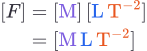
Speed is distance ÷ time, so it is [L T⁻¹]. Acceleration is speed ÷ time: [L T⁻²]. And force is mass × acceleration:
(1.9)
The dimensions are colour-coded throughout: [M] violet, [L] blue, [T] orange. Build a few yourself in Fig. 1.22.
velocity = displacement ÷ time
[L] ÷ [T]
= [M⁰ L¹ T⁻¹]
Replace each quantity by its dimensions, then add the powers of each brick.
acceleration = change in velocity ÷ time
[L T⁻¹] ÷ [T]
= [M⁰ L¹ T⁻²]
Replace each quantity by its dimensions, then add the powers of each brick.
force = mass × acceleration
[M] × [L T⁻²]
= [M¹ L¹ T⁻²]
Replace each quantity by its dimensions, then add the powers of each brick.
velocity = displacement ÷ time
[L] ÷ [T]
= [M⁰ L¹ T⁻¹]
Replace each quantity by its dimensions, then add the powers of each brick.
Fig. 1.22 Replace each quantity by its dimensions, then add up the powers.
Key idea
Dimensions describe the kind of a quantity, not its size or its unit. 5 m/s and 300 km/h are very different speeds, but both are [L T⁻¹].
Watch out
[L] means “the dimensions of length”, not a length. Don’t confuse the dimension [T] with a time t, or with the period T of a pendulum.
Example 1.9
Find the dimensions of (a) momentum, which is mass × velocity, and (b) pressure, which is force ÷ area.
Given
Velocity: [L T⁻¹]
Force: [M L T⁻²]
Area: [L²]
Solution
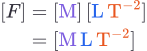
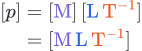
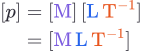
(a) Replace mass and velocity by their dimensions:
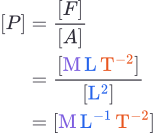
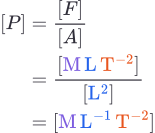
(b) Divide the dimensions of force by those of area:
Answer
(a) [M L T⁻¹] (b) [M L⁻¹ T⁻²]
Check yourself
What are the dimensions of acceleration?


A centimetre is smaller than a metre, so the number should get bigger, not smaller.

That’s right
[L T⁻²]. Acceleration is velocity, [L T⁻¹], divided by time, [T].