Chapter 1 · Units and Measurement
1.3 Significant Figures
Every measurement has some uncertainty. In Fig. 1.15 the pencil tip lies between the 7.3 cm and 7.4 cm marks. We are sure of the 7 and the 3, but the last digit is judged by eye: one student may write 7.36 cm, another 7.37 cm.


7
8
cm


7.36 cm
7.3 is read off the marks. The 6 is judged by eye between two millimetre marks.
Fig. 1.15 The 7 and the 3 are read off the marks; the 6 is a careful estimate.
The digits we are sure of, plus the first uncertain one, are the of a measurement. So 7.36 cm has three. Writing 7.3612 cm would claim a that the scale simply doesn’t have.
Key idea
Write every digit you are sure of, add one estimated digit, and stop.
1.3.1 Counting significant figures
Zeros are the tricky part, because a zero may be measured or may only place the decimal point. Five rules settle every case:
- Non-zero digits always count: 7.36 has three significant figures.
- Zeros between non-zero digits count: 40.02 has four.
- In a number less than 1, zeros before the first non-zero digit don’t count: 0.0402 has three.
- Trailing zeros without a decimal point don’t count: 4020 has three.
- Trailing zeros after a decimal point do count: 40.20 has four.
3 significant figures
The zeros in front only place the point; the 0 between 4 and 2 counts.
0.0402
3 significant figures
The zeros in front only place the point; the 0 between 4 and 2 counts.
0.0402
3 significant figures
The end zero has no decimal point after it, so NCERT does not count it.
4020
4 significant figures
The end zero comes after the decimal point, so it was measured and counts.
40.20
4 significant figures
In scientific notation every digit of a counts; the power of ten never does.
4.020 × 10³
Fig. 1.16 Click a number to see which of its digits count.
Was 4020 m measured to the nearest metre or the nearest ten metres? settles it, because every digit before the power of ten counts: 4.02 × 10³ m has three significant figures, while 4.020 × 10³ m has four.
Changing the unit only moves the decimal point, so it never changes the count (Fig. 1.17). And , such as the 2 in 2πr, have as many significant figures as we like.
4 significant figures
4 significant figures
4 significant figures
4 significant figures
2.308 cm
23.08 mm
0.02308 m
2.308 × 10⁴ µm
Fig. 1.17 The same measurement has four significant figures in every unit.
Example 1.6
How many significant figures are there in each of these?
(a) 0.0450 kg (b) 3.00 × 10⁸ m s⁻¹ (c) 20.08 s (d) 1500 m (e) 0.00072 m
Solution
(a) The leading zeros don’t count, but the final zero does.
(b) Every digit before the power of ten counts.
(c) The zero lies between non-zero digits, so it counts.
(d) By rule 4 the trailing zeros don’t count. Measured to the nearest metre, it should be written 1.500 × 10³ m.
(e) The zeros only place the decimal point.
Answer
(a) 3 (b) 3 (c) 4 (d) 2 (e) 2
Check yourself
How many significant figures does 0.00250 m have?


A centimetre is smaller than a metre, so the number should get bigger, not smaller.

That’s right
3. The leading zeros only place the point; the 2, the 5 and the final zero are all significant.
1.3.2 Significant figures in calculations
A calculator can’t make a measurement more precise. Divide 25.42 g by 3.2 cm³ and it shows 7.94375, but most of those digits mean nothing. Two rules keep results honest:
- Multiplying or dividing: keep as many significant figures as the least precise number has.
- Adding or subtracting: keep as many decimal places as the number with the fewest decimal places.
2.34 m
3 s.f.
1.2 m
2 s.f.
2.34 × 1.2 = 2.808 m²
→ 2.8 m²
Keep two significant figures: the fewest of any measured number.
Fig. 1.18 Multiplying: 1.2 m has two significant figures, so the area keeps two.
2
1
.
1
1
8
1
.
0
1
.
0
1
3
+
1
3
.
1
2
3
→ 31.1 m
18.0 m is known only to a tenth of a metre, so the sum keeps one decimal place.
Fig. 1.19 Adding: 18.0 m has one decimal place, so the sum keeps one.
Example 1.7
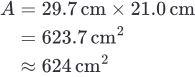
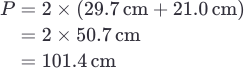
A sheet of A4 paper measures 29.7 cm by 21.0 cm. Find its area and its perimeter, each to the correct number of significant figures.
Given
Length = 29.7 cm: three significant figures, one decimal place
Breadth = 21.0 cm: three significant figures, one decimal place
Solution
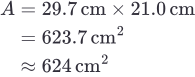
The area is a product, so it keeps three significant figures:
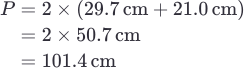
The perimeter is a sum, so it keeps one decimal place. The 2 is exact and doesn’t limit it:
Answer
624 cm² and 101.4 cm
Example 1.8
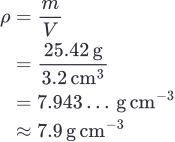
A small metal block has a mass of 25.42 g and a volume of 3.2 cm³. Find its density.
Given
Mass m = 25.42 g: four significant figures
Volume V = 3.2 cm³: two significant figures
Solution
Density is mass divided by volume:
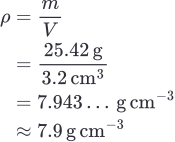
The volume has only two significant figures, so the density keeps two.
Answer
7.9 g cm⁻³
Check yourself
What is 12.6 m + 3.27 m, written correctly?
A centimetre is smaller than a metre, so the number should get bigger, not smaller.
That’s right
15.9 m. 12.6 m has one decimal place, so the sum, 15.87 m, is rounded to one decimal place.
1.3.3 Rounding off
When we drop digits, we the last digit we keep. Look at the first digit being dropped:
- Less than 5: leave the kept digit alone. 1.623 → 1.62
- More than 5: raise it by one. 1.627 → 1.63
- Exactly 5 (and nothing but zeros after it): make the kept digit even. 1.625 → 1.62, but 1.635 → 1.64
Drop less than 5
stays
1.623 → 1.62
Drop more than 5
goes up
1.627 → 1.63
Drop exactly 5
odd up, even stays
1.625 → 1.62
1.635 → 1.64
Rounding to three significant figures. The grey digit is the one dropped.
Fig. 1.20 Rounding to three significant figures. The grey digit is the one dropped.
Did you know?
Why round a 5 to the even digit?
A 5 sits exactly halfway. Always rounding it up would push results upwards on average; rounding to the even digit sends half the 5s up and half down, so the errors cancel out.
In a long calculation, keep one extra digit in the middle steps, and round off only the final answer.
1.3.4 Uncertainty in a calculation
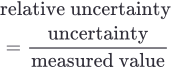
A finer way to judge precision is the :

(1.8)
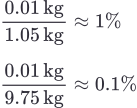
Two masses, 1.05 kg and 9.75 kg, each measured to the nearest 0.01 kg, both have three significant figures. Yet
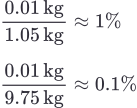
When values are multiplied or divided, their relative uncertainties roughly add up. That is why the least precise value always controls the answer.