Chapter 1 · Units and Measurement
1.2 The International System of Units
The SI was agreed in 1960 by the General Conference on Weights and Measures, the . It is a : its larger and smaller units differ by powers of ten. Science, industry and trade use it almost everywhere, and so does this book.
1.2.1 Base quantities and base units
The SI has seven base quantities, listed in Table 1.1. Hover over a unit to see how it is defined. , the study of motion and forces, needs only the first three: length, mass and time.
BASE QUANTITY
UNIT
SYMBOL
FIXED BY
metre
m
speed of light, c
kilogram
kg
Planck constant, h
second
s
caesium frequency
ampere
A
elementary charge, e
kelvin
K
Boltzmann constant, k
mole
mol
Avogadro constant
candela
cd
luminous efficacy
Table 1.1 The seven SI base quantities, with their units and symbols.
1.2.2 Units fixed by nature
Until 2019 the kilogram was a metal cylinder kept near Paris, with copies around the world, India’s among them. But an object can change. A speck of dust or a scratch would change the kilogram for everyone, and the copies were slowly drifting apart.
So since 20 May 2019 every SI unit has been fixed by the exact value of a , a quantity that is the same everywhere and never changes.
UNTIL 2019
SINCE 2019


The kilogram was the mass of this platinum–iridium cylinder, kept near Paris.
speed of light, c
Planck constant, h
caesium frequency
elementary charge, e
Boltzmann constant, k
Avogadro constant
luminous efficacy
Seven constants of nature, each given an exact value. Every SI unit is built from them.

0
1 m

Light crosses one metre in 1/299 792 458 of a second, about 3.3 billionths of a second. Shown here 500 million times slower.

0
1 m

Light crosses one metre in 1/299 792 458 of a second, about 3.3 billionths of a second. Shown here 500 million times slower.
0
1 m
Light crosses one metre in 1/299 792 458 of a second, about 3.3 billionths of a second. Shown here 500 million times slower.
Fig. 1.6 The old kilogram was an object. Today all seven base units are fixed by constants of nature. The pulse shows light crossing one metre, 500 million times slower than in reality.
Take the metre: it is the distance light travels in a vacuum in 1/299 792 458 of a second. That makes the speed of light exact, by definition:

(1.3)
The second comes from an atomic clock: it is the time taken by 9 192 631 770 oscillations of the radiation given out by atoms.
Did you know?
The CSIR–National Physical Laboratory in New Delhi keeps India’s national standards. Its caesium clocks keep Indian Standard Time, and it still looks after India’s copy of the old kilogram, number 57.
Example 1.2
Light travels 299 792 458 m in one second. The road from Delhi to Mumbai is about 1400 km long. How many times could light cover it in one second?
Given
Light travels 299 792 458 m in 1 s
Delhi to Mumbai ≈ 1400 km
Solution
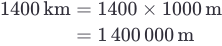
First, write the road distance in metres:
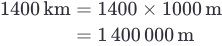
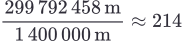
Then divide the distance light covers in one second by the road distance:
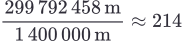
Answer
about 214 times
1.2.3 Writing units correctly
Unit symbols follow a few simple rules, the same all over the world:
- No plural s and no full stop: write 5 kg, never 5 kgs.
- Symbols are lower case, except for units named after people: m and s, but N and K. The names are always lower case: newton, kelvin.
- Leave a space between the number and the symbol: 25 kg, not 25kg. Degrees of angle are the exception: 30°.
- Use only one slash: m s⁻² or m/s², never m/s/s.
UNIT NAME
SYMBOL
NAMED AFTER
metre
m
—
kilogram
kg
—
second
s
—
newton
N
Isaac Newton
kelvin
K
Lord Kelvin
ampere
A
André-Marie Ampère
Names always take small letters. A symbol starts with a capital only when the unit is named after a person.
Fig. 1.7 A unit named after a scientist has a capital symbol, but its name is written in lower case.
Check yourself
Which of these is written correctly?


A centimetre is smaller than a metre, so the number should get bigger, not smaller.

That’s right
5 kg: a lower-case symbol, no plural s, a space before it and no full stop.
1.2.4 Plane angle and solid angle
The SI also has units for angles. In Fig. 1.8, an arc of length s on a circle of radius r makes a θ at the centre:

(1.4)
Its unit is the (rad). One radian is the angle whose arc is exactly as long as the radius. Move the slider to open the angle.

θ



r
s
θ = s / r
s = 0.5 r
θ = 0.5 rad
≈ 28.6°
Arc length, s
s = 0.5 r
0.5 r
r
2 r
π r
2π r

θ



r
s
θ = s / r
s = 0.5 r
θ = 0.5 rad
≈ 28.6°

θ


r
s
θ = s / r
s = r
θ = 1 rad
≈ 57.3°
The arc is exactly as long as the radius.

θ


r
s
θ = s / r
s = 2 r
θ = 2 rad
≈ 114.6°

θ


r
s
θ = s / r
s = π r
θ = π rad
= 180°
Half a circle.

θ

r
s
θ = s / r
s = 2π r
θ = 2π rad
= 360°
A whole circle.
Fig. 1.8 θ in radians is the arc length divided by the radius.
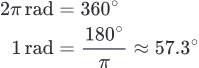
A full turn has an arc of 2πr, so it measures 2π radians:
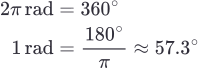
(1.5)
A measures how widely a cone opens out. If a cone from the centre of a sphere of radius r cuts out an area A on its surface, then

(1.6)
Its unit is the (sr). The whole sphere has an area of 4πr², so it measures 4π sr.





r
A
Ω
Ω = A / r²
A is the area the cone cuts on a sphere of radius r drawn around its tip.
A cone that cuts an area of exactly r² makes 1 steradian.
Fig. 1.9 A solid angle Ω cuts out an area A on a sphere of radius r.
Key idea
Radians and steradians are ratios of two lengths or two areas, so they have no dimensions. We still write rad or sr, to show that a number is an angle.
Example 1.3
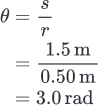
A point on the rim of a wheel of radius 0.50 m moves 1.5 m along the rim. Through what angle has the wheel turned?
Given
Radius r = 0.50 m
Arc length s = 1.5 m
Solution
First, find the angle in radians with Eq. (1.4):
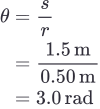
Then convert it to degrees, using 1 rad ≈ 57.3°:

Answer
3.0 rad, about 172°
1.2.5 Very large and very small numbers
Physics spans sizes from a nucleus, about 10⁻¹⁵ m across, to our galaxy, about 10²¹ m. Instead of writing out all the zeros, we use :

(1.7)
The radius of the Earth, 6 400 000 m, becomes 6.4 × 10⁶ m, and 0.000 053 m becomes 5.3 × 10⁻⁵ m. Moving the decimal point left gives a positive power of ten; moving it right gives a negative one.
6
4
0
0
0
0
0
.

6 places
= 6.4 × 10⁶ m
0
.
0
0
0
0
5
3

5 places
= 5.3 × 10⁻⁵ m
Move the point until one non-zero digit is in front of it. Count the hops: moving left gives a positive power of ten, moving right a negative one.
Fig. 1.10 Count the places the decimal point moves.


SIZE
≈ 10⁻¹⁵ m
A nucleus
The core of an atom: protons and neutrons packed tightly together.
Zoom out
≈ 10⁻¹⁵ m
nucleus
atom
you
Earth
galaxy


SIZE
≈ 10⁻¹⁵ m
A nucleus
The core of an atom: protons and neutrons packed tightly together.





SIZE
≈ 10⁻¹⁰ m
An atom
Mostly empty space: a cloud of electrons around a tiny nucleus.

SIZE
≈ 10⁰ m
You
About 1.6 m tall: the size of things a metre scale can measure.

SIZE
≈ 10⁷ m
The Earth
Its diameter is about 1.28 × 10⁷ m.




SIZE
≈ 10²¹ m
The Milky Way
Our galaxy is about 100 000 light years across.
Fig. 1.11 Powers of ten, from a nucleus to the Milky Way. Move the slider to zoom out.
An stands for a power of ten, so we can write 1 km instead of 10³ m and 1 nm instead of 10⁻⁹ m. Table 1.2 lists the common ones.
PREFIX
SYMBOL
POWER
FOR EXAMPLE
giga
G
10⁹
a 3 GHz processor
mega
M
10⁶
a 500 MW power station
kilo
k
10³
a 2 km walk
centi
c
10⁻²
a 15 cm pencil
milli
m
10⁻³
a 1 mm grain of sand
micro
µ
10⁻⁶
a 2 µm bacterium
nano
n
10⁻⁹
a 2 nm wide DNA strand
pico
p
10⁻¹²
a 100 pm atom
Table 1.2 Common SI prefixes, with an everyday example of each.
Example 1.4
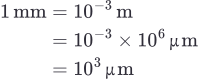
How many micrometres are there in one millimetre?
Given
milli- means 10⁻³, so 1 mm = 10⁻³ m
micro- means 10⁻⁶, so 1 m = 10⁶ μm
Solution
Write 1 mm in metres, then turn the metres into micrometres:
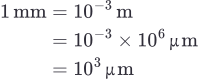
Answer
1000 μm
The of a number is the power of ten nearest to it. Write the number as a × 10ᵇ. If a is 5 or less, the order of magnitude is 10ᵇ; if it is more than 5, the order is 10ᵇ⁺¹. So the Earth’s radius, 6.4 × 10⁶ m, has an order of magnitude of 10⁷ m.

1
2
3
4
5
6
7
8
9
10
a
a ≤ 5: the order of magnitude is 10ᵇ
a > 5: it is 10ᵇ⁺¹

6.4 × 10⁶ m → 10⁷
For a number written as a × 10ᵇ, round a to 1 or to 10. NCERT puts the cut-off at 5.
Fig. 1.12 Up to 5, a rounds down to 1; above 5, it rounds up to 10.
Did you know?
Some books put the cut-off at √10 ≈ 3.16 instead of 5, because √10 sits halfway between 1 and 10 on a scale of powers of ten. The two rules disagree only when a lies between 3.16 and 5. This book follows NCERT and uses 5.
Orders of magnitude compare things at a glance. An atom, about 10⁻¹⁰ m across, is 10⁵ times larger than its nucleus. If the nucleus were a marble 1 cm wide, the atom would be a kilometre across.

If a nucleus were a 1 cm marble…

…its atom would be about 1 km across.
10⁻¹⁰ m ÷ 10⁻¹⁵ m = 10⁵
Fig. 1.13 An atom is almost entirely empty space.




Sun
Earth
light travels at 3 × 10⁸ m/s · takes about 500 s




Sun
Earth

light travels at 3 × 10⁸ m/s · takes about 500 s
Sun
Earth
light travels at 3 × 10⁸ m/s · takes about 500 s
Fig. 1.14 Light leaves the Sun and reaches the Earth about 500 s later.
Example 1.5
Sunlight takes about 500 s to reach the Earth. Taking c = 3.0 × 10⁸ m s⁻¹, estimate the distance from the Sun to the Earth and its order of magnitude.
Given
Time t ≈ 500 s = 5.0 × 10² s
Speed of light c = 3.0 × 10⁸ m s⁻¹
Solution
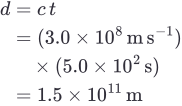
Distance is speed multiplied by time:
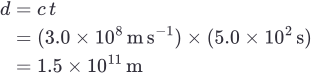
Since 1.5 is less than 5, the order of magnitude is 10¹¹ m.
Answer
1.5 × 10¹¹ m; order 10¹¹ m
Check yourself
What is the order of magnitude of 5.3 × 10⁻⁵ m?
A centimetre is smaller than a metre, so the number should get bigger, not smaller.
That’s right
10⁻⁴ m. Since 5.3 is more than 5, round it up to 10: 10 × 10⁻⁵ = 10⁻⁴.