CLASS 11 · PHYSICS · CHAPTER 1
Units and Measurement
Measurement, SI units, significant figures and dimensions
Physics begins with measurement. Before we can say how fast a stone falls or how far away the Moon is, we need units to measure with, an honest way to write down what we measured, and a quick check that our equations make sense. This chapter gives you all three.
In this chapter
1.1
Introduction
Units, base and derived quantities, systems of units
1.2
The International System of Units
The seven base units, angles, prefixes and powers of ten
1.3
Significant Figures
Writing a measurement honestly, and rounding off
1.4
Dimensions of Physical Quantities
Building every quantity from mass, length and time
1.5
Dimensional Formulae and Dimensional Equations
A table of dimensions, and converting units
1.6
Dimensional Analysis and its Applications
Checking equations, and finding new ones
Summary
Key ideas, formulas to keep, points to ponder
Chapter 1 · Units and Measurement
1.1 Introduction
A tailor measuring a sleeve, a doctor reading a temperature, a shopkeeper weighing rice: each one compares a quantity with a fixed amount of the same kind. That is what measurement means.
Anything we can measure is a . The fixed amount we compare it with is a . So every measurement is a number together with a unit:

(1.1)
Here n, the , says how many times the unit fits into the quantity Q. A desk 1.2 m long is 1.2 times as long as one metre. Without its unit, the number means nothing.
the desk

1 m
0.2 m
1.2
number
m
unit
Fig. 1.1 Every measured value has two parts: a numerical value (blue) and a unit (orange).
1.1.1 Why we need standard units
Measure a desk with your and you may count 6; your friend may count 7. Neither of you is wrong. Hands differ, so a hand span makes a poor unit.
Riya
0 spans


Aman
0 spans

Riya
0 spans


Aman
0 spans

Riya
1 span

Aman
1 span

Riya
2 spans
Aman
2 spans
Riya
3 spans
Aman
3 spans
Riya
4 spans
Aman
4 spans
Riya
5 spans
Aman
5 spans
Riya
6 spans
Aman
6 spans
Riya
6 spans
Aman
7 spans
Fig. 1.2 The same desk measured with two different hand spans gives two different numbers.
Early units such as the cubit (the length of a forearm) and the foot came from the human body, and they changed from town to town. A good unit must be well defined, must not change with time or place, and must be easy to reproduce anywhere.
Did you know?
The word “metre” comes from the Greek metron, “measure”. When France introduced the metre in the 1790s, it was meant to be one ten-millionth of the distance from the North Pole to the equator.
1.1.2 Changing the unit
A smaller unit fits into a length more times, so the number grows. The same desk is 1.2 m, 120 cm or 1200 mm. Try it in Fig. 1.3.
the desk
1.2
m
1 metre fits along the desk 1.2 times.
the desk

120
cm
1 centimetre fits along the desk 120 times.
the desk
1.2
m
1 metre fits along the desk 1.2 times.
the desk
1200
mm
1 millimetre fits along the desk 1200 times.


1 cm = 10 mm
Fig. 1.3 One desk, three units. Click a unit and watch the number change while the length stays the same.
The desk doesn’t change; only its description does. If n₁ is the numerical value in a unit u₁, and n₂ is the value in a unit u₂, then

(1.2)
The bigger the unit, the smaller the number.
Example 1.1
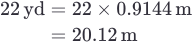
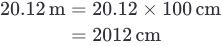
A cricket pitch is 22 yards long, and 1 yard = 0.9144 m. Express its length in metres and in centimetres.
Given
Length of the pitch = 22 yd
1 yd = 0.9144 m and 1 m = 100 cm
Solution
First, replace the yard by its value in metres:
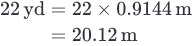
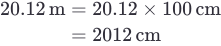
Then, since 1 m = 100 cm, multiply by 100:
Answer
20.12 m = 2012 cm
Check yourself
A rod is 2.5 m long. How long is it in centimetres?


A centimetre is smaller than a metre, so the number should get bigger, not smaller.

That’s right
A centimetre is a hundredth of a metre, so the rod is 2.5 × 100 = 250 cm long.
1.1.3 Base and derived quantities
We don’t need an independent unit for every quantity. A few , such as length, mass and time, are chosen as building blocks, and their units are the . Every other quantity is a , built from the base quantities, and has a .
Area is length × length, so its unit is m². Speed is length ÷ time, so its unit is m s⁻¹. Density is mass ÷ volume, so its unit is kg m⁻³.
DERIVED QUANTITIES
metre, m
kilogram, kg
second, s
Area = L × L
square metre, m²
Speed = L ÷ T
metre per second, m/s
Density = M ÷ L³
kilogram per cubic metre

Fig. 1.4 Derived quantities are built from base quantities.
1.1.4 Systems of units
A complete set of base and derived units is a . Three were common before 1960: the (centimetre, gram, second), the (foot, pound, second) and the (metre, kilogram, second). In 1960 the world agreed on a single one, the , or SI.
SYSTEM
LENGTH
MASS
TIME
CGS
centimetre
gram
second
FPS
foot
pound
second
MKS
metre
kilogram
second
SI
metre
kilogram
second
SI keeps the metre, kilogram and second and adds four more base units.
Fig. 1.5 The base units of length, mass and time in three older systems and in the SI.
Watch out
A spacecraft lost to mixed units
In 1999 NASA lost its Mars Climate Orbiter. One team’s software reported thruster data in pound-force seconds, while the navigation software expected newton seconds. Never mix systems of units in one calculation.
Check yourself
Which of these is a derived quantity?
A centimetre is smaller than a metre, so the number should get bigger, not smaller.
That’s right
Speed is length divided by time, so it is built from two base quantities.